Always Committed To
Making Better Machine
Precision-Engineered Livestock Solutions for Global Farms. High-Efficiency Mixers, Collectors & Feeders Designed to Maximize Your Productivity.

 English English
Views: 0 Author: Site Editor Publish Time: 2026-08-24 Origin: Site


Purchasing farm equipment involves much more than simply acquiring new machinery. It often highlights a critical operational bottleneck on your farm. Inefficient feed delivery causes severe labor bloat, unacceptable feed waste, and highly inconsistent herd nutrition. If you want to scale your agricultural operations, you must transition away from manual or suboptimal feeding methods. Modern farms demand mechanized, accurately metered solutions to protect their margins and improve livestock health. Integrating a properly sized Feed Delivery Box directly tackles these daily distribution challenges. This guide provides an objective, evidence-based framework to help you navigate the purchasing process. You will learn how to evaluate, compare, and select a system based on true operational requirements rather than manufacturer marketing hype. We explore capacity planning, discharge compatibility, and mechanical durability to ensure your investment drives immediate farm efficiency.
Match capacity to herd size and terrain: Over-sizing leads to soil compaction and wasted capital; under-sizing multiplies labor hours.
Prioritize discharge mechanism compatibility: The choice between auger, belt, or gravity discharge dictates the types of feed (grain, silage, mixed rations) you can effectively distribute without bridging or separation.
Material choice impacts lifespan: Assess the corrosiveness of your feed additives to determine if painted steel, galvanized, or stainless steel is required.
Dealer proximity matters: Operational success relies heavily on immediate access to replacement parts (bearings, auger flighting) to prevent feeding downtime.
Calculating daily feed volume serves as your foundational metric. You must measure this volume in both cubic feet and total weight. Rations vary wildly in their physical density. Light, fluffy forage takes up massive volume but weighs very little. Conversely, dense mineral pellets consume minimal space but max out payload capacities quickly. Define the ideal number of delivery trips per day. Fewer trips minimize labor costs significantly. They also prevent feed spoilage inside the equipment. A properly sized Feed Delivery Box keeps your feeding schedule highly efficient.
Consider your terrain and infrastructure constraints carefully.
Ground Conditions: Muddy or uneven terrain restricts your maximum payload weight. Heavy rigs will compact soil heavily. They easily get stuck in wet spring pastures. Winter conditions introduce deep ruts and frozen ground. You must select equipment that navigates your worst-case seasonal terrain safely.
Bunk and Trough Height: Measure your existing feed bunks meticulously. Ensure the discharge spout clears these structures natively. You want to avoid expensive aftermarket modifications entirely. Modifying a spout often alters the flow angle negatively, which causes subsequent plugging issues.
Finally, analyze your feed composition variability. Identify exactly what materials you distribute daily. Dry grains flow easily like water. Pelleted feed requires gentle handling to prevent crushing. Sticky custom mixes often contain heavy liquid molasses. High-moisture commodities demand aggressive agitation. Your material type directly dictates the necessary slope angles. It also determines your internal agitation needs for a consistent pour.
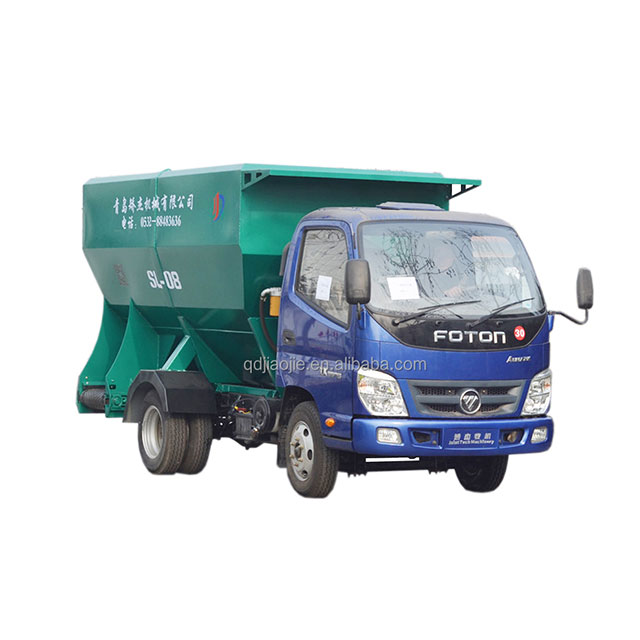
Farms operate differently across regions. Manufacturers build several distinct configurations to match these varied workflows. You must align the equipment style to your daily logistics.
These units mount directly onto a dedicated commercial chassis. They work best for multi-site operations. If you require highway travel between distant pastures, this is your top choice. Truck systems offer incredibly fast dispensing speeds. They provide superior maneuverability in tight commercial feedlots. The trade-off involves substantially higher upfront capital. You must also maintain a dedicated truck engine, transmission, and drivetrain. Ensure your operators hold the necessary commercial driving licenses if traversing public highways frequently.
Trailer configurations attach directly to your existing tractor inventory. They remain ideal for localized, single-site farms. You save significantly on initial capital expenses. You utilize tractor horsepower you already own. However, you face longer turning radiuses. Navigating tight gate entries becomes much more challenging. Transport times between distant pastures also increase. Tractors simply travel much slower than commercial trucks.
Smaller operations often prefer slide-in units. They work perfectly for seasonal feeding schedules. You can mount them securely on a standard flatbed truck. When feeding season ends, you remove the skid using a tractor loader or forklift. Your flatbed truck then serves multiple purposes. This versatility maximizes your overall asset utilization year-round.
Configuration Comparison Summary
Configuration Type | Ideal Operational Use Case | Primary Advantage | Main Trade-off |
|---|---|---|---|
Truck-Mounted | Multi-site, frequent highway travel | Maximum speed and tight maneuverability | High upfront capital and engine maintenance |
Trailer/Pull-Type | Single-site, localized pastures | Lower expense, uses existing tractors | Slower transport, larger turning radius |
Stationary/Slide-in | Seasonal feeding, small scale | Extreme asset versatility | Requires mounting and dismounting labor |
Mechanical components determine how effectively your system operates daily. Focus on features that directly improve your feeding outcomes. Marketing gimmicks do not feed livestock; reliable mechanics do.
Evaluate Discharge Mechanisms: Auger systems provide excellent precision. They handle dense grains effortlessly. However, robust augers risk grinding delicate pelleted feed into dust. Dust reduces palatability and creates respiratory risks for cattle. Belt or conveyor systems treat feed gently. They preserve feed integrity beautifully. Keep in mind, belts can struggle in freezing temperatures. Ice buildup causes slippage. Belts also handle highly cohesive, wet materials poorly.
Assess Material Construction: Standard painted steel offers affordability initially. Yet, it degrades quickly in corrosive environments. High-mineral supplements and salts act as severe corrosive agents. Stainless steel and aluminum resist this chemical damage. A stainless steel Feed Delivery Box features a higher upfront cost. Yet, it significantly extends the equipment lifecycle. You replace the box far less often, saving valuable capital long-term.
Analyze Metering and Scale Integration: Precision matters immensely for livestock health. It also dictates your profit margins. Evaluate your options for integrated load cells. Look for bright, durable digital indicators visible in direct sunlight. Integrated scales ensure precise ration delivery per pen. This exactness prevents costly overfeeding. It guarantees your nutrition program remains highly accurate day after day.
Operational realities often challenge manufacturer marketing claims. You must protect your feed integrity vigorously. You also need to minimize daily maintenance headaches. Practical farm experience reveals several critical implementation risks.
Preventing bridging and separation stands as a massive priority. Feed flow relies heavily on gravity and physical design. Poor designs cause "rat-holing" where feed sticks to the sides. Look for boxes featuring steep interior slope angles. A minimum 40 to 45-degree slope is absolutely essential. You also need strong internal agitators. These components prevent sticky, high-moisture feeds from hanging up. Bridged feed requires manual prodding, which poses severe safety risks to operators.
Weatherproofing directly impacts your feed quality. Evaluate tarp systems, rigid lids, and seal quality carefully. Electric roll tarps save time and prevent operator injury. Water ingress causes rapid mold growth inside the hopper. Moldy feed renders entire loads completely unusable. It also forces your staff to perform a grueling manual clean-out. Always prioritize heavy-duty waterproof seals to protect your expensive rations.
Cleanout accessibility prevents dangerous cross-contamination. Operators must safely access the interior regularly. You will likely switch between different feed batches. Moving from medicated to non-medicated feed requires a pristine environment. FDA regulations regarding Veterinary Feed Directives (VFDs) demand strict adherence. Assess how easily a worker can remove residual feed safely. Look for cleanout doors that require no specialized tools to open. Always implement Lockout/Tagout procedures before interior cleaning.
Do not fall into the trap of evaluating equipment solely on sticker price. True value comes from long-term operational efficiency. Factor in your expected daily labor savings. Calculate the hours per week you will reduce through faster feeding cycles. Saving just two hours a day equals over seven hundred hours annually. A premium Feed Delivery Box pays for itself quickly when it slashes daily labor hours. It allows your crew to focus on higher-value farm tasks.
Look far beyond the standard warranty document. You must investigate the local dealer network thoroughly. Farm equipment breaks down eventually under heavy use. A shattered auger bearing requires immediate, same-day replacement. Waiting 48 hours for a shipping facility is simply not viable. Cattle must eat on schedule. Prioritize brands backed by local, well-stocked dealerships. Ask if the dealer runs mobile service trucks to your area to handle unexpected breakdowns.
Take these actionable next steps before making a final decision:
Audit your current daily feed weights accurately. Measure exactly what you dispense.
Measure all aisle widths, gate clearances, and bunk heights across your property.
Request specific demonstration units from local equipment dealers.
Test the unit thoroughly with your exact, customized feed mix.
Ask for references from local operators running similar livestock setups.
Selecting the right equipment streamlines your entire farm operation profoundly. A perfectly matched feed unit aligns with your specific ration types. It navigates your unique terrain constraints effortlessly. It also integrates seamlessly with your existing machinery fleet. We strongly advise buyers to prioritize functional reliability above all else. Local parts availability matters far more than non-essential technological add-ons. Fancy touchscreens break; heavy-duty steel endures. Keep your focus strictly on durability, cleanout access, and precise discharge capabilities.
Are you ready to upgrade your livestock nutrition program? Optimize your daily workflow today. Contact our sales engineering team directly. Provide us with your specific feed type and herd size. We will deliver a localized equipment recommendation tailored perfectly to your unique operational bottlenecks. You can also download our farm equipment ROI calculator to model your expected labor savings accurately.
A: Standard gravity and auger boxes usually fail with high-moisture feeds. Wet material clumps together, causing severe bridging inside the hopper. If you feed silage, you need specialized systems. Look for equipment featuring live bottoms, exceptionally steep slope angles, or twin-auger designs to keep wet feed moving smoothly without jamming.
A: The choice comes down to payload capacity and corrosion resistance. Aluminum is much lighter, which increases your legal road payload and reduces soil compaction in wet pastures. It also resists rust effectively. Painted steel offers superior structural rigidity at a lower price point, but it requires diligent maintenance to prevent rust over time.
A: Realistic maintenance requires strict routines to avoid costly breakdowns. Perform daily visual checks of all discharge mechanisms, safety guards, and tarp seals. You should grease bearings and PTO shafts weekly to prevent friction damage. Finally, conduct monthly inspections of your hydraulic lines and verify your scale calibrations to ensure accurate feeding weights.
A: Yes, retrofitting is structurally possible using aftermarket load cells. However, you must prepare for potential challenges. Older frames may require custom fabrication to fit the weight sensors properly. Additionally, achieving accurate calibration on modified equipment can be highly difficult, so professional installation by a certified technician is highly recommended.


