

Views: 0 Author: Site Editor Publish Time: 2026-08-02 Origin: Site


A perfectly formulated poultry diet looks flawless on paper. However, this theoretical precision is completely useless if the actual physical mix delivered to the birds is inconsistent. When a batch lacks true homogeneity, flocks inevitably experience uneven growth and significant performance drops. Poor mixing directly drives higher mortality rates. Young birds suffer the most because they cannot compensate for missing nutritional gaps. You also face wasted feed expenditures as vital nutrients miss their intended biological targets. Advanced mixing technology bridges this critical gap between nutritional theory and actual intake. A modern TMR Mixer serves as the definitive solution for commercial poultry operations. It ensures precise nutrient distribution in every single bite. You maximize flock uniformity and secure your feed investments. Precision equipment transforms raw ingredients into a reliable, consistent ration every time.
A severe amplification effect occurs when feeding young animals. A day-old chick consumes only a few grams of feed over 24 hours. They rely entirely on that tiny volume for survival and development. If micro-ingredients are poorly distributed, one bird receives a toxic dose of a mineral. Another bird receives absolutely nothing. This disparity causes immediate flock unevenness. Nutrient deficiencies stunt skeletal development and compromise the immune system. You lose the genetic potential of the bird within the first week. These early losses compound dramatically as the flock ages.
Ingredient segregation poses another massive risk during feed production. Raw materials behave differently based on their physical properties. They vary in particle size, shape, and bulk density. Dense minerals like limestone tend to sink rapidly. Light ingredients like wheat bran float to the top. This separation happens during transport and discharge if the ingredients lack proper binding. Segregation ruins a good formula before the birds even see it. You must control this physical separation to maintain nutritional integrity.
You measure mixing success using a strict scientific benchmark. The target outcome is a consistent nutrient profile in every single bite. We measure this consistency using the Coefficient of Variation (CV). The industry standard mandates a CV of less than 10%. Hitting this target guarantees reliable nutrient dispersion across the entire batch. Anything higher than 10% indicates dangerous inconsistencies. Hitting this metric ensures your formula performs as intended.
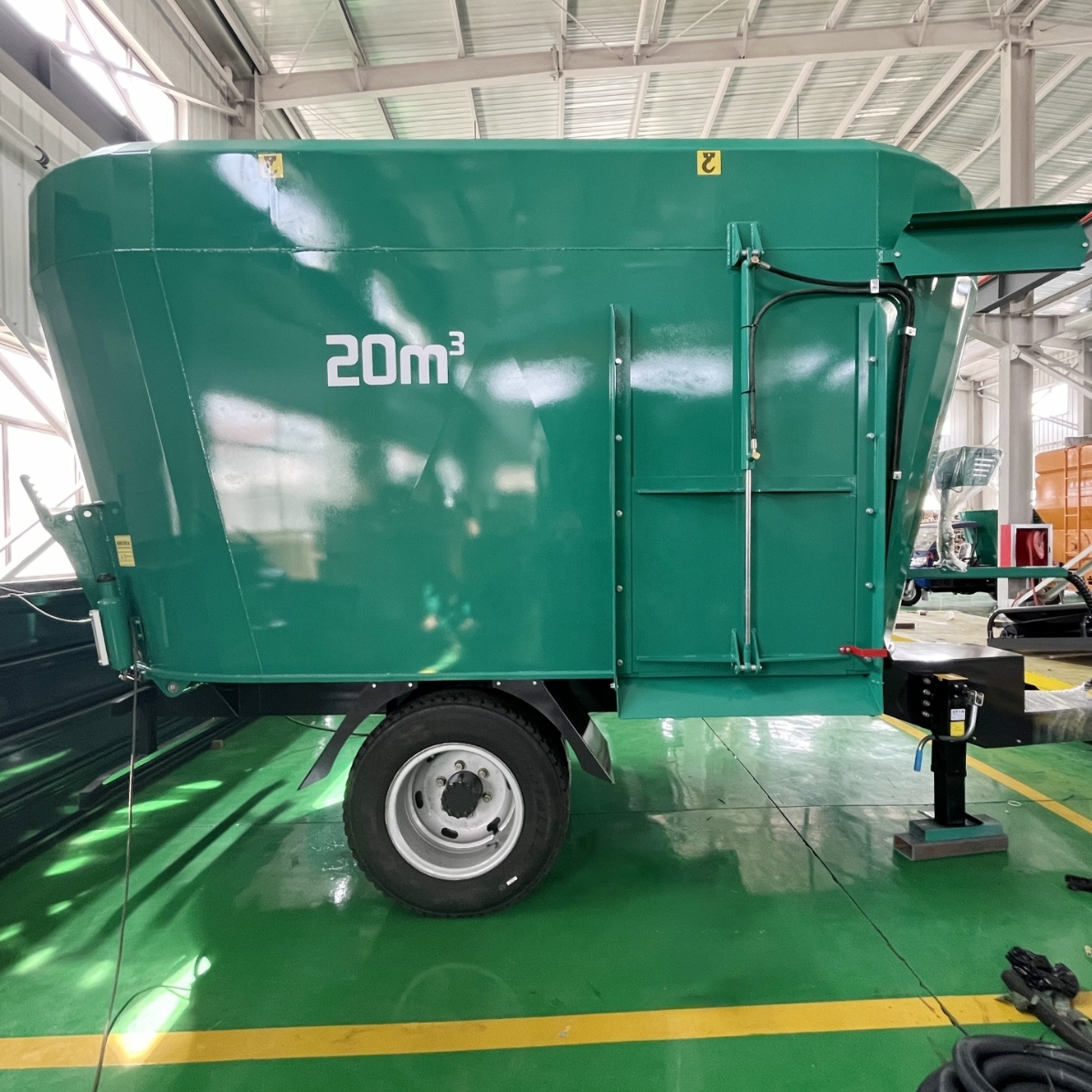
Total Mixed Ration (TMR) principles originally transformed the dairy industry. Now, adapted technology proves highly effective for commercial poultry operations. Poultry diets involve high volumes and complex multi-ingredient formulas. A modern TMR Mixer handles these demanding rations effortlessly. They manage varied particle sizes better than traditional ribbon blenders. You achieve complete integration of bulky fiber, fine powders, and dense minerals. This crossover technology elevates poultry feed precision to new standards.
Mechanical superiority sets these machines apart from legacy equipment. Advanced auger and paddle designs ensure true three-dimensional movement inside the mixing chamber. Ingredients move up, down, and across simultaneously. This aggressive intersecting flow prevents material stagnation. Older machines often suffer from dead zones. Fine powders and heavy minerals accumulate in corners or along the bottom shaft. Three-dimensional mixing eliminates these zones entirely. Every particle remains in constant motion until discharge.
Liquid addition capabilities represent another critical advantage. Modern poultry diets require precise application of liquid fats, oils, and enzymes. Applying liquids uniformly without creating clumps is notoriously difficult. Legacy equipment often fails here, creating massive fat balls. These clumps trap expensive medications and vitamins inside them. Advanced mixing equipment utilizes specialized spray nozzles and high-shear zones. They coat dry particles evenly. You avoid clumping entirely and protect the availability of expensive micro-ingredients.
Choosing the correct equipment format depends entirely on your existing farm layout. Stationary mixers work best for centralized feed mills. They suit large-scale integrated farms utilizing automated conveying systems. You install them permanently inside a dedicated milling facility. They offer exceptionally high throughput for rapid batching. They integrate seamlessly into fully automated weighing and dosing systems. However, they lack direct-to-house distribution flexibility. You must rely on secondary transport systems like auger lines or delivery trucks to move the feed.
Conversely, mobile solutions offer distinct operational freedoms. A Trailed TMR Mixer serves multi-house operations exceptionally well. It is the perfect choice for farms lacking a centralized automated delivery infrastructure. You gain high mobility and direct discharge capabilities. Operators mix the batch and drive directly to individual poultry houses. They discharge the finished feed straight into the local silos or hoppers. This method requires reliable tractor availability. Operators also need careful navigation skills between buildings.
You should follow a clear decision framework when selecting your unit. Evaluate your current labor availability. Consider your existing feed delivery automation. Calculate your daily batch volume requirements. Mobile units reduce reliance on complex conveyor networks. Stationary units maximize pure tonnage per hour. Assess your infrastructure before committing to a format.
Equipment Format Comparison Chart
| Evaluation Factor | Stationary Mixer | Trailed TMR Mixer |
|---|---|---|
| Best Suited For | Centralized mills, automated facilities | Multi-house farms, decentralized setups |
| Distribution Method | Requires secondary conveyors or trucks | Direct-to-house mobile discharge |
| Infrastructure Need | Permanent building, power grids | Tractor, accessible farm roads |
| Flexibility | Low (fixed location) | High (can service multiple remote sites) |
Shortlisting the right machine requires rigorous technical evaluation. You cannot rely on visual inspections alone to judge performance. Strict criteria ensure the equipment meets biological requirements.
Buying excellent equipment represents only the first step. You must implement strict operational protocols to protect the mix quality. Loading sequence stands out as the most critical daily variable. You must establish a non-negotiable protocol for loading ingredients.
You must establish routine calibration and auditing procedures. Advanced mixing equipment is never a "set and forget" investment. Mechanical parts wear down over time. You must schedule quarterly mixer profile testing. Use reliable tracers like synthetic amino acids or micro-salt particles. These tests verify ongoing performance. They warn you when auger flights need adjustment or replacement.
Operator training controls the final human element. Staff must understand the science behind the process. Over-mixing causes severe particle degradation. It grinds ingredients into fine dust, which damages bird gizzard function. Under-mixing causes dangerous ingredient segregation. Strict adherence to manufacturer mixing times is absolutely required. Equip your operators with automated timers to remove human error.
A: The ideal timeframe typically ranges from 3 to 6 minutes, depending on the specific auger design. You must follow the manufacturer's precise guidelines. Operating beyond this range risks over-mixing. Over-mixing degrades particle sizes, generates excessive dust, and negatively impacts bird digestion.
A: You should conduct a CV test bi-annually at an absolute minimum. Many commercial operations test quarterly. You must also run an immediate test whenever you replace worn auger parts, change blade configurations, or significantly alter your core feed formula.
A: Yes, they handle liquids effectively if equipped with the correct hardware. You must specify liquid-injection nozzles during purchase. Proper nozzles atomize fats and oils, spraying them evenly over the moving feed mass. This technical requirement prevents fat clumps and ensures uniform energy distribution.
A: Dead zones result from poor internal geometry and a lack of intersecting cross-flow action. Material pushes into corners or rests beneath horizontal shafts without re-entering the mixing stream. Modern vertical mixing technology solves this by enforcing constant three-dimensional movement, eliminating stagnant accumulation areas entirely.


