

Views: 0 Author: Site Editor Publish Time: 2026-07-30 Origin: Site


Processing whole bales remains one of the most energy-intensive and time-consuming steps in daily feed preparation. Farm operators process massive amounts of roughage every single day. This makes mechanical bottlenecks a serious threat to operational productivity. Mismatching bale size, density, or moisture content with the capabilities of your machinery leads to excessive fuel consumption. You will also experience premature equipment wear and inconsistent ration sorting by the herd. Operators often struggle to maintain mixing speed without overloading the tractor. Over time, these daily inefficiencies harm both your machinery lifespan and your herd's nutritional intake.
Evaluating equipment upgrades or adjusting forage harvesting strategies requires understanding the exact mechanical limits of your mixing equipment. This guide breaks down how to align bale characteristics with mixer specifications to ensure reliable, efficient feed delivery. You will learn to correctly specify tub geometry, power requirements, and auger styles for your unique forage.
Farm profitability relies heavily on efficient daily routines. Forcing an oversized or excessively dense bale into an undersized TMR Mixer causes extreme peak torque loads on the PTO, gearbox, and driveline. Planetary gearboxes face immense stress when dense, frozen baleage drops directly onto vertical augers. This mechanical strain often triggers shear pins to snap or cam clutches to slip. Frequent driveline shock events inevitably lead to catastrophic planetary failure and expensive downtime.
Fuel and labor inefficiencies compound these mechanical risks. Increased processing time per batch leads to higher daily diesel consumption and extended operator hours. Imagine spending an extra ten minutes per batch across four daily batches. You lose over two hundred hours of labor annually. Tractor lugging burns additional diesel fuel while operators wait for unbroken forage clumps to slowly shear apart.
Nutritional consistency risks pose an even greater threat to your bottom line. Extended mixing times required to break down large bales can over-process softer ingredients. Ingredients like corn silage, ground corn, or protein concentrates pulverize while waiting for long hay to chop. This leads to a physically ineffective fiber (peNDF) level in the final ration. Herds easily sort over-processed rations at the bunk. Cows consume the rich concentrates and leave the long stemmy fiber behind. Sub-acute ruminal acidosis (SARA) and depressed butterfat levels often follow.
An optimized system processes the target bale size in a predictable timeframe. Success criteria dictate finishing a whole-bale incorporation in under ten to fifteen minutes. The equipment achieves this without lugging the tractor or compromising the structural integrity of the roughage. Proper fiber length promotes rumination, ensuring herd health and peak milk production.
Balers create distinctly different internal forage structures depending on the bale format. Understanding these structures helps you configure your machinery correctly.
Round bales present unique breakdown challenges. They tend to peel layer by layer and wrap around the central auger. This wrapping effect chokes the mixing action. Preventing this requires robust kicker plates at the base of the auger. You must also install aggressive lower knife configurations to aggressively cut the unrolling mat of hay. Large square bales behave differently. They flake off in dense, heavy chunks. These concrete-like slabs can wedge between the tub wall and the auger. Square bales require adequate vertical clearance and optimized tub geometry to prevent bridging above the augers.
Bale Type Processing Comparison Chart
| Bale Format | Breakdown Behavior | Required Machinery Configuration | Common Pitfalls |
|---|---|---|---|
| Standard Round Bales | Unrolls in continuous mats; tends to wrap. | Aggressive lower knives; heavy-duty kicker plates. | Wrapping around auger column; tub spilling. |
| Large Square Bales | Fractures into solid, heavy flakes. | Wide tub walls; adjustable restrictor baffles. | Flakes bridging above augers; extreme torque shock. |
| High-Density Baleage | Sticky, heavy, resists shearing action. | Two-speed gearbox; carbide-coated top knives. | Tractor lugging; broken shear pins. |
Moisture content and weight fundamentally alter your processing requirements. Wet bales, such as baleage or haylage, demand significantly more horsepower to process than dry hay. A dry round bale might weigh one thousand pounds. A similarly sized bale of wet haylage can exceed two thousand pounds. Heavy, wet bales also reduce the total number of bales you can process per batch. Load cells and running gear possess strict weight limits. Overloading damages the weigh bars, leading to inaccurate ration delivery.
You must also account for the "Fluff Factor." When a tightly bound bale breaks apart, its volume expands significantly. Density drops as the bale introduces air and begins tumbling. A four hundred cubic foot mixer cannot efficiently process three hundred cubic feet of dense, unbroken forage. The expanded volume simply overflows the tub. Forage clumps fall over the sides before the knives can chop them.
As a core evaluation metric, calculate the required "expansion volume" based on your primary forage source. You must perform this calculation before determining your minimum tub size. Multiply the dense bale volume by an expansion factor of two or three depending on crop type. This guarantees enough free space for proper tumbling action.
Farm layout directly dictates equipment form factors. Deployment strategies typically fall into two categories: trailed units and stationary feed centers.
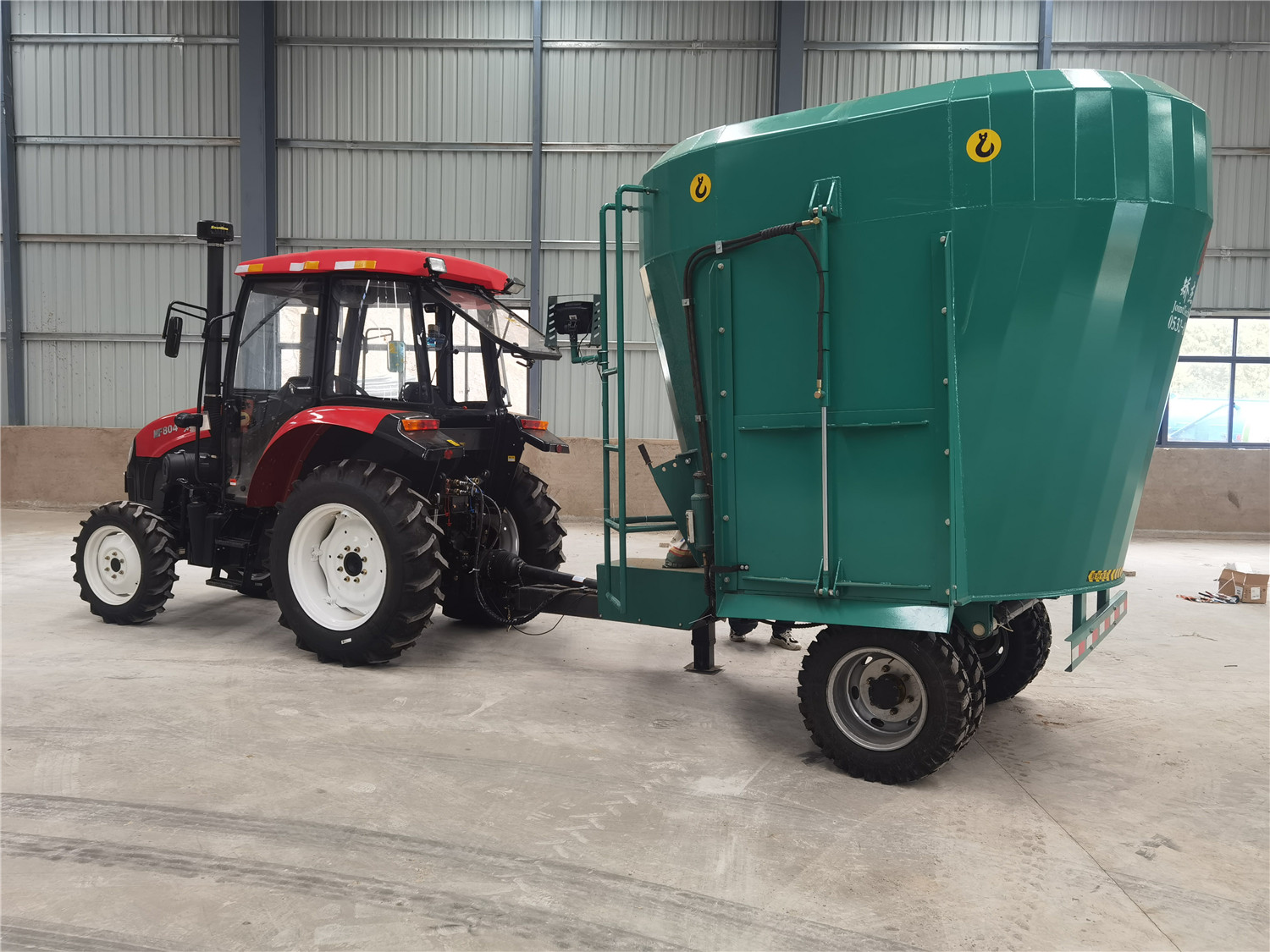
The Trailed TMR Mixer provides immense operational flexibility. Operators tow these units directly to multiple commodity sheds, bunker silos, or field-side bale stacks. This mobility eliminates the need to transport every individual feed ingredient to a central hub. It allows a single operator to load the tub with a separate machine, then mix the ration while in transit to the feed bunk. This transit-mixing reduces overall cycle times. Trailed units prove ideal for operations spread across multiple barns or farms utilizing various remote bale storage locations.
Stationary configurations offer different benefits. Centralized feed centers suit farms where all ingredients arrive at one dedicated building. Bales are brought to the mixer via loaders or conveyors. Stationary setups allow for large electric motor drives. Electric drives significantly reduce energy costs compared to running a high-horsepower diesel tractor. However, the farm's electrical infrastructure must handle the massive startup draw of processing a whole bale. Many rural grids cannot support a two-hundred horsepower electric motor starting under a heavy load.
Use the following shortlisting logic to base this decision on your farm's reality:
Operations feeding highly coarse or heavily compacted bales face a critical choice. Should you chop the bales directly in the tub, or pre-process them before they enter the ration?
Direct mixing constraints present real physical hurdles. Relying solely on vertical augers to chop and mix large bales requires premium machinery. You need thick-flighting augers, usually five-eighths or three-quarters of an inch thick. You also face frequent knife replacement. Constantly shearing dry, dusty bales wears down standard steel knives quickly. Dull knives pull and tear the forage instead of slicing it cleanly. This tearing action ruins the nutritional structure and drastically increases mixing time.
The case for pre-processing using tub grinders or bale processors deserves careful review. Pre-processing reduces the physical workload on the primary mixing tub. Tub grinders feature massive rotors designed specifically to obliterate dense bales in minutes. This ensures consistent fiber length before the forage ever enters the final ration. The mixer then only performs blending duties, which extends its mechanical lifespan.
However, pre-processing includes a major trade-off. It requires purchasing a second piece of capital equipment. It also introduces an additional handling step into your daily routine. You must weigh the diesel fuel saved during the mixing cycle against the fuel burned running a separate tub grinder.
Always perform an assumption check when evaluating dealer claims. If a dealer claims their vertical tub can rapidly process intact five-by-six high-moisture bales without pre-processing, require verifiable data. Ask for case studies detailing expected knife lifespan. Demand baseline PTO horsepower requirements. Without this data, you risk buying undersized equipment prone to failure.
Standard specification sheets often hide the practical realities of daily operation. Use this detailed checklist to specify machinery capable of handling heavy bale usage without breaking down.
The critical next-step action involves demanding a complex-ration demonstration on your farm. Do not rely on showroom visits. Request a demo using your densest, highest-moisture bales. Evaluate the actual mix time from the tractor seat. Monitor the tractor's fuel usage during the breakdown phase. Finally, use a Penn State Particle Separator to evaluate the final ration uniformity. Real-world testing exposes equipment flaws instantly.
Selecting the right feeding equipment goes far beyond merely matching tub volume to your herd size. It requires a precise alignment of tub geometry, auger aggression, and power availability with your specific bale dimensions and densities. Failing to respect these mechanical relationships results in costly inefficiencies. Your tractor burns excessive diesel, your machinery degrades prematurely, and your herd suffers from inconsistent nutrition.
Prioritize equipment that handles your absolute worst-case forage scenario. If your farm occasionally feeds frozen or highly dense wet bales, size your driveline and horsepower for that exact challenge. You want to avoid excessive mixing times that pulverize grain and degrade the overall ration quality.
Keep these final action steps in mind as you evaluate your operations:
A: While physically possible in some models, it is generally inefficient. The expanded volume of a 5x6 bale leaves little room for other ingredients and proper tumbling action, often resulting in spillage or over-processing.
A: Yes, significantly. High-moisture baleage is heavier and tougher to shear than dry hay, requiring a higher PTO horsepower to maintain auger RPMs and prevent tractor lugging.
A: Wear rates vary by forage type and dirt inclusion, but operations processing multiple whole bales daily should inspect knives monthly. Dull knives increase mixing time, burn more fuel, and pull rather than cut forage, ruining ration consistency.
A: Trailed units often feature a lower loading height and are typically cheaper to maintain or upgrade over time. However, truck-mounted units offer faster transit speeds for geographically spread-out operations. Bale size primarily dictates the tub requirement rather than the carriage method.


