

Views: 0 Author: Site Editor Publish Time: 2026-07-15 Origin: Site


An incorrectly sized handling facility creates major operational bottlenecks. It increases animal stress and poses severe safety risks to both handlers and livestock. You need a properly dimensioned Cattle Chute to keep animals moving smoothly. Determining the right width depends heavily on your specific operation. You must consider whether you manage a uniform herd or run a mixed-size operation. Building a permanent wood or pipe structure requires different dimensional planning than investing in a commercial adjustable handling system. Getting these measurements wrong leads to bruised meat, damaged equipment, and highly dangerous working conditions. This guide covers university-standard dimensions for safe handling setups. We explore structural design evaluations to help you make informed operational choices. Finally, we break down the criteria for purchasing commercial options to ensure you prioritize long-term durability, animal welfare, and handler safety.
Standard Baselines: Ideal internal chute widths range from 18 inches for calves to 28–30 inches for mature bulls, depending on breed and weight.
The "Turnaround" Risk: Chutes wider than 30 inches dramatically increase the risk of cattle attempting to turn around, leading to injury and facility jams.
Design Trade-offs: Fixed-width straight chutes are cost-effective for uniform herds, V-shaped chutes offer flexibility for mixed herds, and commercial adjustable chutes provide the highest safety and throughput but require a higher initial capital expense.
Purchase Criteria: Evaluating commercial adjustable chutes requires scrutinizing the adjustment mechanism (friction vs. pin), build quality, and integration with existing alleyways.
University agricultural extension programs provide heavily researched baselines for handling facilities. These institutions study animal behavior to determine the exact clearances required for safe movement. You cannot rely on guesswork when building or buying handling equipment. Cattle need enough room to walk forward naturally. However, they must not have enough space to spin around. We break down the recommended dimensions based on standard weight classes below.
Calves (under 400 lbs): Handling small calves requires tight constraints. Their bodies are highly agile. They will attempt to escape if they perceive too much open space. The recommended internal width for this class is strictly 16 to 18 inches.
Yearlings & Feeder Cattle (400–800 lbs): This group presents a unique challenge. They carry more mass but retain a lot of nervous energy. A slightly wider clearance is necessary. The recommended internal width falls between 20 and 22 inches.
Mature Cows & Market Cattle (800–1,200 lbs): Adult cattle need more shoulder and hip clearance. You want them to walk into the catch area without rubbing against the sides. The recommended internal width for this class is 24 to 26 inches.
Large Bulls & Pregnant Cows (1,200+ lbs): Handling large herd sires or late-term pregnant cows requires maximum available space. Restricting them too tightly can cause severe distress or physical injury. The recommended internal width is 28 to 30 inches maximum.
Cattle Class | Weight Range (lbs) | Recommended Internal Width (Inches) | Handling Behavior Notes |
|---|---|---|---|
Calves | Under 400 | 16 - 18 | Highly agile; prone to quick turnarounds if space allows. |
Yearlings / Feeders | 400 - 800 | 20 - 22 | Easily spooked; require snug sides to maintain forward focus. |
Mature Cows | 800 - 1,200 | 24 - 26 | Need adequate hip clearance to prevent bruising. |
Large Bulls | 1,200+ | 28 - 30 (Max) | Require maximum space; exceeding 30 inches risks wedging. |
You must follow the critical dimension rule during construction or measurement. Always measure width from the inside of the rails. Hardware, bolt heads, hinges, or structural supports must never protrude into the minimum clearance space. Even a half-inch protruding bolt can cause severe hide damage and deep tissue bruising as heavy animals push past it.
Producers must match their equipment to their operational realities. A custom feedlot running thousands of identical steers has vastly different needs than a family ranch running a diverse cow-calf herd. Understanding structural categories helps you align your facility with your specific workflow.
Fixed straight-sided alleys and chutes maintain a uniform width from top to bottom. They are permanent structures often built from heavy steel pipes or wooden planks.
Best for: Operations handling highly uniform herd sizes. Specific finishing feedlots often use this design because every animal passing through is nearly identical in size and weight.
Limitations: They are incredibly dangerous for mixed-size herds. If you run a calf through a straight chute built for a mature cow, the calf will turn around. If you run a large bull through a chute built for yearlings, he will get wedged tightly between the rails.
A V-shaped design features angled sides. It is narrow at the floor and gradually widens toward the top. This geometry accommodates different body sizes without requiring moving parts.
Best for: Budget-conscious cow-calf operations. These ranches need to handle varying animal sizes but may not have the budget for complex adjustable mechanics.
Dimensions: The base typically measures 14 to 16 inches wide. The sides slope outward to reach 30 to 32 inches at the top. This maximum width usually occurs at a standard 5-foot height.
Limitations: The narrow base prevents calves from turning around. However, the aggressive slope can cause issues. Cattle may lose their footing or feel claustrophobic if the slope angles inward too sharply. Hoof placement becomes restricted.
Modern commercial setups prioritize flexibility and restraint. An adjustable Cattle Chute incorporates hydraulic or manual leverage systems to change the internal width dynamically.
Best for: High-throughput operations and veterinary handling. They are essential for ranches prioritizing operator safety and maximum processing efficiency.
Evaluation: High-quality models allow either infinite or stepped adjustments. An operator can shift the internal space from roughly 16 inches up to 31 inches in seconds. This allows a handler to process a 400-lb calf directly after a 1,200-lb cow without halting the workflow.
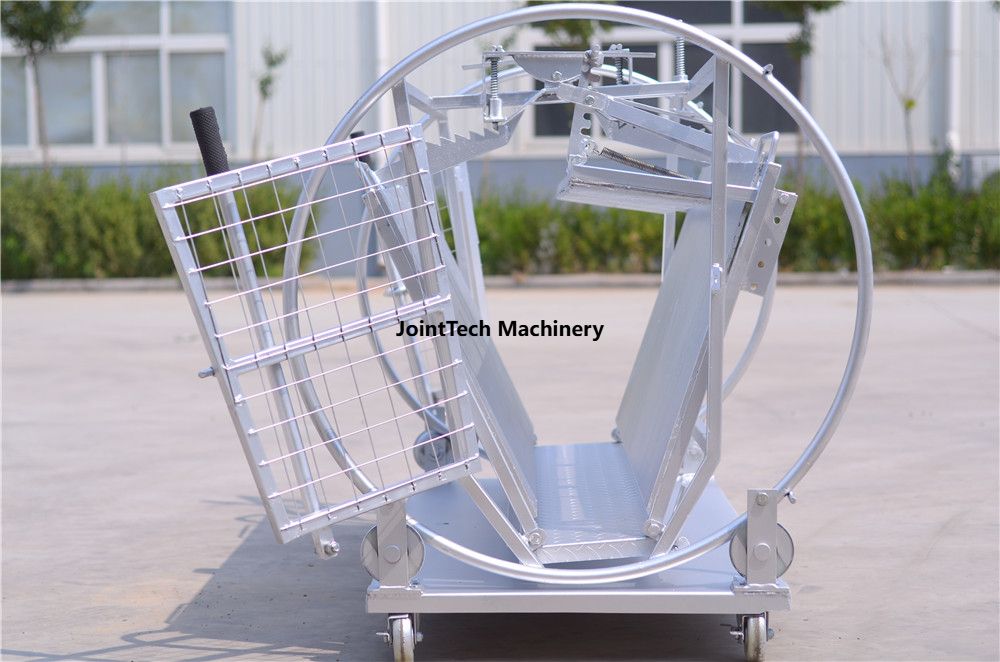
Building or buying a system based on guesses leads to catastrophic failures. Poor dimensions directly impact your bottom line. They destroy efficiency, harm animal welfare, and create hazardous environments for workers.
Throughput Bottlenecks (Too Narrow): When an alley is too narrow, cattle feel trapped. They will balk and refuse to enter. Handlers then resort to excessive prodding and shouting. This chaos spikes cortisol levels in the livestock. High stress immediately prior to handling or transport degrades meat quality. The beef industry refers to this condition as "dark cutters," which severely reduces the carcass value at the packing plant. Slow movement also means you pay for more labor hours.
The Turnaround Hazard (Too Wide): A space that is too wide invites disaster. Consider a scenario involving a 600-lb calf. If you push this calf into a 28-inch alleyway, it will likely attempt a 180-degree turn. Halfway through the turn, the animal gets stuck in a U-shape. This completely halts your operation. You often have to dismantle the side panels to free the animal. Emergency extractions are dangerous, time-consuming, and highly stressful for the trapped calf.
Handler Injury Risks: Gaps that are too wide allow excessive animal movement within a squeeze mechanism. If the animal can shift its weight back and forth, it gains leverage. This increases the likelihood of kicking. Unpredictable thrashing makes it incredibly dangerous for veterinarians to administer vaccines, apply ear tags, or perform pregnancy checks. A proper fit pins the animal securely, protecting both the handler's arms and the animal's joints.
Investing in commercial equipment is a major decision. You must look past marketing fluff and assess the actual hardware durability. Not all handling equipment performs equally under pressure. You need to scrutinize specific mechanical features before making a purchase.
Adjustment Mechanism Reliability: The lock mechanism secures the animal. It must hold tight when a heavy animal pushes against the sides. You will encounter two main styles. Friction locks allow for infinite adjustment. You can stop the squeeze at any exact millimeter. However, low-quality friction locks wear down over time and may slip under heavy pressure. Pin or ratchet locks offer stepped adjustment. They lock into specific grooves. Ratchet locks are highly durable and rarely fail, though they lack the micro-adjustability of a friction system.
Parallel Squeeze vs. Scissor Squeeze: How the sides close around the animal matters immensely.
Parallel Squeeze: This design moves both side panels evenly toward the center. It keeps the animal perfectly balanced and upright. Vets strongly prefer this style. We consider parallel squeezing a higher-tier feature.
Scissor (V-Squeeze): This design hinges at the bottom. Only the top sections move inward. It forces the animal into a V-shape. If an operator squeezes too aggressively, the animal can lose its footing and collapse downward.
Material & Steel Gauge: Structural integrity defines longevity. You must evaluate the steel gauge based on your herd's temperament and your processing volume. A lighter 14-gauge steel tubing might survive a gentle dairy herd. However, heavy 11-gauge steel is mandatory for aggressive range bulls or high-volume feedlot environments. Thicker steel resists bending when a 1,500-lb animal hits the headgate at full speed.
Safety & Accessibility: Look beyond the main squeeze function. Does the equipment offer emergency side exits? If an animal collapses, you need to open the entire side panel immediately to let it out. Check for easy-access branding doors that swing open smoothly. Assess whether the system integrates well with a palpation cage for safe veterinary access to the rear of the animal.
Width measurements mean nothing if cattle refuse to enter the facility. Site integration requires an understanding of bovine psychology. How you connect your pens to your final handling point dictates your success.
The Funnel Effect: Cattle flow smoothly when the environment guides them naturally. The working alley leading up to the final processing point must smoothly transition into the correct width. Abrupt narrowings cause instant hesitation. If a wide sweep tub suddenly forces cattle into a tight 20-inch gap without a gradual funnel, they will balk. You must design smooth, angled transitions.
Visual Continuity: Cattle have poor depth perception. They balk at sudden shadows, puddles, and dead ends. You must ensure the transition area maintains consistent lighting. Solid sides on the approach alley prevent cattle from seeing outside distractions. However, they need a clear line of sight straight ahead to the exit. If the end of the alley looks like a solid wall, they will refuse to move forward.
Flooring Integrity: Width is irrelevant if cattle slip and fall. Fear of slipping causes cattle to freeze. You must assess the flooring at the immediate entry and exit points. Bare dirt turns to slick mud quickly. Smooth concrete is a major hazard. You should install ribbed steel plates, heavy-duty rubberized mats, or deeply grooved concrete. Secure footing gives cattle the confidence to step forward into the enclosure without hesitation.
Determining the correct dimensions for your handling facility requires a structured approach. You must start by auditing your herd's weight variance. Knowing your smallest calf and your largest bull gives you your operational parameters. If you are building DIY permanent structures for a cow-calf operation, we strongly recommend implementing a V-shaped design to accommodate this variance safely.
However, if you manage a high-volume or heavily mixed herd, prioritize commercial solutions. Advise your operation to invest in a high-quality, parallel-adjustable squeeze system. Upgrading to professional-grade equipment maximizes your operational ROI. It drastically reduces labor time, minimizes costly meat bruising, and significantly decreases the risk of traumatic handler injuries.
A: Yes. A chute wider than 30 inches allows calves and yearlings to turn around. This specific movement can trap the animal in a U-shape, which immediately halts operations and requires dangerous extractions.
A: Most standard working facilities require a side height of 60 to 72 inches. This vertical height is necessary to prevent nervous or athletic cattle from attempting to jump over the side panels during processing.
A: The sweep tub generally transitions from a wide radius of 10 to 12 feet. It then funnels down gradually to the single-file alley width of 18 to 28 inches that feeds directly into the squeeze mechanism.
A: Curved alleys leverage cattle's natural circling behavior. They also prevent the animals from seeing the squeeze mechanism and humans at the end of the line, which significantly reduces balking and improves overall flow.


